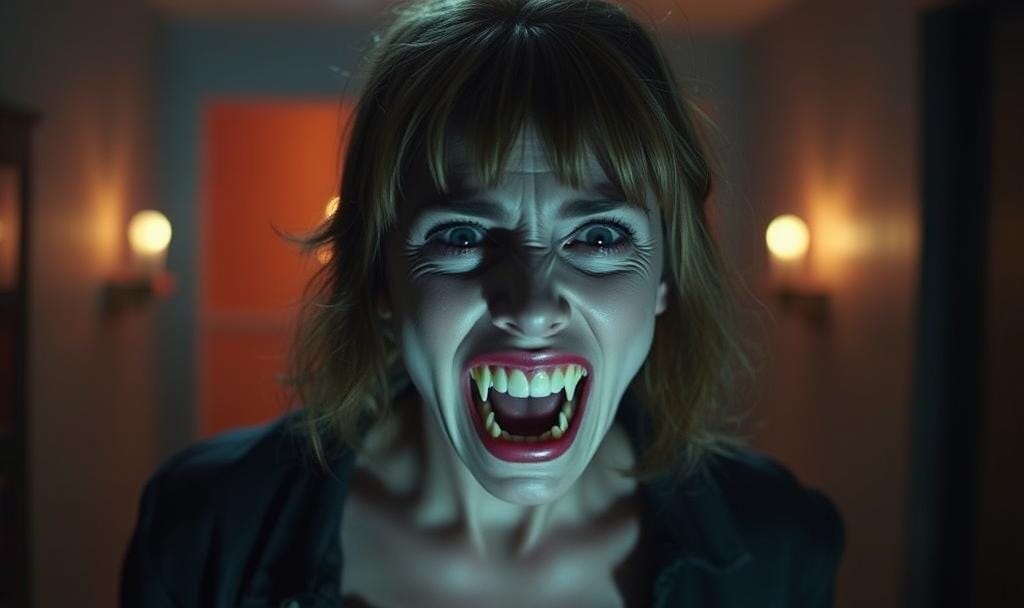
This past weekend at Kripalu Center for Yoga and Health, thirteen fierce women, my assistant, and I shared space, tears, gasps, and laughs. We were discussing emotional eating and how it can become a gateway to Intuitive Eating. What I noticed most – what I always notice when things get real – was not their lack of food and nutrition knowledge or “willpower” (a dastardly word if there ever was one), but the sheer weight of the rules they had been carrying around—rules about what to eat, when, how much, in response to what. Rules about what it means to be good, to be bad, to be worthy.
And I realized: this is the real horror story.
The Setup
Imagine being born into a world where the body you inhabit is immediately suspicious, constantly monitored, and never quite right. Imagine being told—quietly and loudly, directly and through every cultural channel—that your worth is tied to how small you can make yourself.
You internalize these rules so early you don’t even realize they’re rules. They feel like truth with a capital T. You learn that hunger can’t be trusted, that pleasure is dangerous temptation, that being too much is worse than being nothing at all. You learn to doubt the very sensations that connect you to life.
The Descent
This is where it starts to get really scary: once you follow the rules to the point of no return, you discover they can’t be followed. No matter how hard you try, the finish line keeps moving.
Lose weight? Now it’s about maintenance. Gain strength? Now you’re “bulky.” Eat clean? You’re obsessive. Rest? You’re lazy.
The game is rigged. And the longer you play, the more you lose: connection with your body, trust in your judgment, faith in your own capacity to know what you need. Instead of living inside your life, you hover outside of it, watching, critiquing, forever projecting into the future when you might finally get it right.
The Haunted House
Horror movies love isolation, and diet culture creates a haunted house in your own mind. You begin to believe you’re the only one who hasn’t figured it out. You hide the binge, the skipped meal, the obsessive thoughts, the shame. You think, If I could just follow the rules better, I’d be free.
But the walls close in. You miss out on what your mind and body were meant to do—create, connect, experience joy—because you’re too busy fighting a phantom.
You don’t write the poem, because you’re counting calories.
You don’t take the trip, because you’re waiting to “lose the weight first.”
You don’t dance, because you’re too aware of how you look instead of how it feels.
You don’t savor the meal with friends, because you’re calculating how to “make up for it” later.
You don’t rest, because you think rest must be earned.
You don’t feel the sun on your skin, the water on your body, the pleasure in your mouth, because you’re busy translating every sensation into judgment.
What could have been beauty becomes burden. What could have been connection becomes comparison. What could have been joy becomes shame.
The Reveal
And here’s the final twist, the gut punch, the thing that makes this a true American horror story:
It was all made up.
The rules weren’t natural laws. They weren’t truths about health or worth. They were invented, upheld, and enforced by a culture that hates women, fears bodies, and profits from keeping us in cages of self-doubt.
You even learned to do it to yourself and other women. But it’s all been a colossal waste of time, money, and effort.
You believed it—because who wouldn’t? The set design was flawless. The actors were convincing. The story was everywhere.
Waking Up
The best horror stories play with the mind. You wonder, Was all a nightmare? What if I just wake up?
And in that moment, the power shifts. You see that the monster was never your body—it was the story about your body.
You don’t simply wake up though—you rise up. Changed. Your eyes shining, your appetite undeniable. You return not cleansed, but crowned by what was meant to destroy you. This is what it means to survive: to take the monster’s shape and call it your own.
You reclaim hunger—not as a threat to be silenced, but as a growl, a pulse, an ancient knowing that says I am alive and I will not be contained.
You remember pleasure—not as sin, but as blood, heat, and birthright, the very force that terrifies a culture built on control.
You return to your body—not as a haunted house to be exorcised, but as the dark temple where creation and destruction both belong to you.
This is the twist they never wanted you to see: you were never the victim in the horror story. You were the thing with teeth. That’s not just survival—it’s freedom.